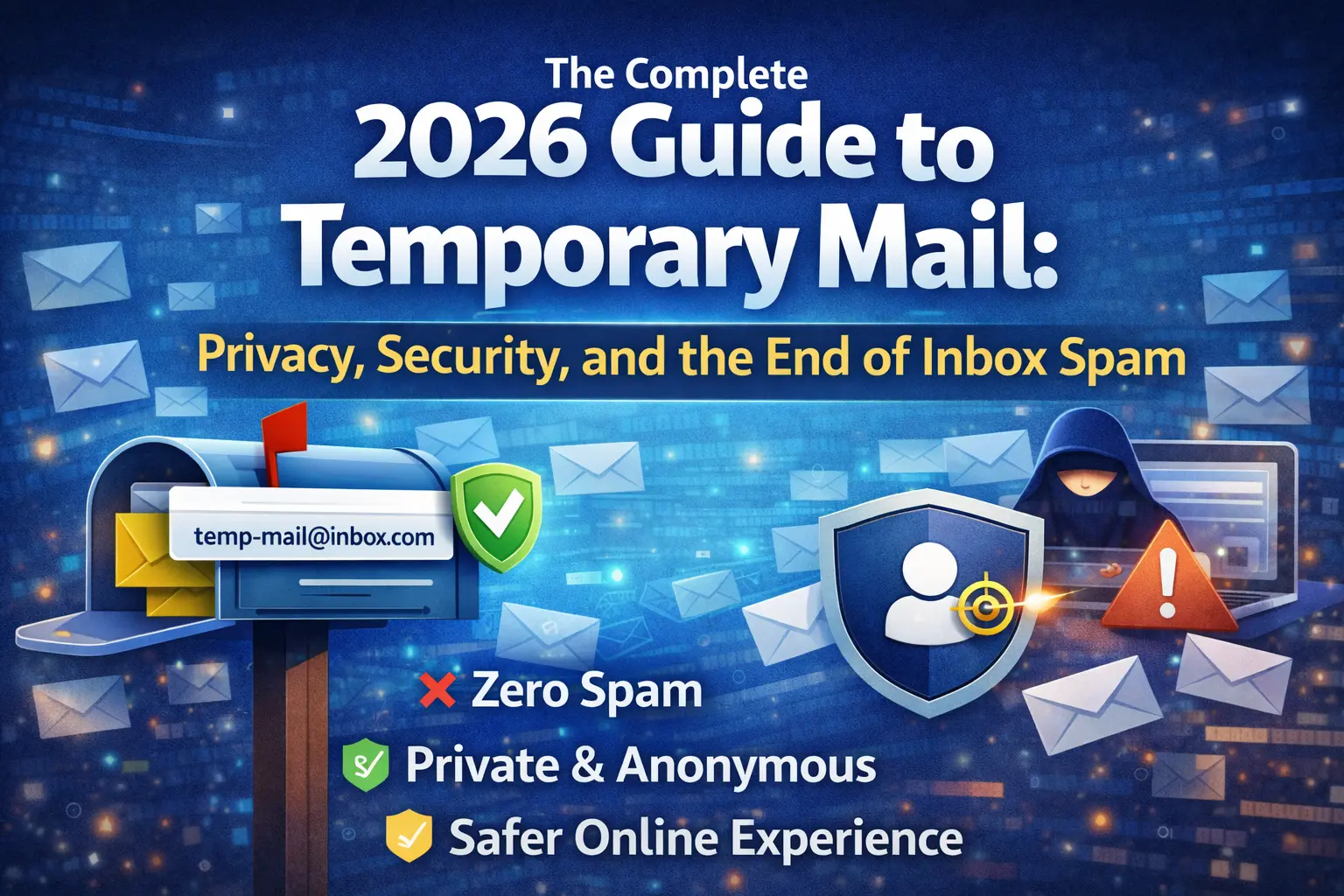
The Complete 2026 Guide to Temporary Mail: Privacy, Security, and the End of Inbox Spam
Introduction: The Battle for Your Inbox
In 2026, our email address is more than just a communication tool; it is our digital Social Security number. It’s linked to our bank accounts, our social media, our healthcare portals, and our professional identities. Yet, we hand it out to every random coupon site, "free" eBook offer, and mandatory WiFi login we encounter.
The result? A digital avalanche of spam, sophisticated phishing attempts, and a loss of personal privacy. This is where temporary mail (frequently called fake mail) steps in. This guide explores the mechanics, the ethics, and the strategic use of disposable email addresses to reclaim your digital peace.
1. What is Temporary Mail? (Beyond the Basics)
At its core, temporary mail is a service that generates a fully functional email address that exists for a specific duration—usually ranging from 10 minutes to several days. Unlike your permanent Gmail or Outlook account, these addresses require no personal information to create and leave no digital footprint back to your real identity.
Why the term "Fake Mail" is Misleading
While people search for "fake mail," these addresses are technically very real. they can receive HTML emails, attachments, and verification links. They are only "fake" in the sense that they are not tied to a human identity or a long-term storage server.
2. The Evolution of Email Privacy in 2026
Data privacy laws like GDPR and CCPA have tried to curb data abuse, but the "Shadow Profile" industry is still booming. When you give a website your real email, you aren't just giving them a way to contact you; you are giving them a key to your cross-platform behavior.
How Temporary Mail Breaks the Chain:
Decoupling Identity: By using a unique disposable address for every service, you prevent data brokers from "stitching" your profiles together.
Eliminating the "Lead" Value: Marketers pay for active, long-term leads. A temporary address that expires in 20 minutes has zero market value.
3. The Top 7 Use Cases for Disposable Email
Why would a standard user need a "burn" email? The applications are more common than you think:
A. Bypassing "Gated Content"
We’ve all seen it: "Download our free PDF guide!" Only after you click do you realize you must provide an email. Using a fake mail address lets you get the download link without joining a lifetime marketing funnel.
B. Public WiFi Authentication
Airports, cafes, and hotels often trade "free" WiFi for your data. These portals are notorious for selling email lists. Use a temporary address to authenticate and keep your primary inbox safe.
C. Testing Beta Software and Apps
If you’re a tech enthusiast or a developer, you likely sign up for dozens of tools a month. Using your real email for a tool you might delete in five minutes is a recipe for clutter.
D. Avoiding "Unsubscribe" Friction
Some companies make it notoriously difficult to unsubscribe. If you use a temporary address for the initial signup, there is no need to unsubscribe—the address simply ceases to exist.
E. Online Shopping One-Timers
Need a 10% discount code for a store you’ll never visit again? Temporary mail is the perfect solution.
4. How to Choose a Temporary Mail Provider
Not all services are created equal. In 2026, a high-quality provider should offer:
Feature | Importance | Why it Matters |
|---|---|---|
Domain Variety | High | Some sites block common ".com" temp domains. You need unique suffixes. |
Refresh Speed | Critical | You shouldn't wait 5 minutes for a verification code. |
Attachment Support | Medium | Useful if the "freebie" you're getting is sent as a file. |
Privacy Policy | High | The provider shouldn't log your actual IP address. |
5. The Security Risks of Permanent Email
Your primary email is a "Single Point of Failure." If a hacker gains access to your Gmail, they can click "Forgot Password" on your bank, your Amazon account, and your private cloud storage.
By using temporary mail for non-essential services, you reduce the surface area of your digital life. If a site you signed up for with a fake email gets hacked, the hackers get a dead address that leads nowhere.
6. Technical Insights: How Fake Mail Works
Behind the scenes, these services run specialized mail servers (MTAs). When a mail is sent to user123@temp-provider.com, the server accepts the packet, displays it in a web interface using AJAX or WebSockets for real-time updates, and then runs a "cron job" to delete the data after the timer hits zero.
Can Websites Detect Temporary Mail?
Yes. Many websites use "blacklist" databases of known temporary mail domains. However, top-tier providers constantly rotate their domains to stay one step ahead of these filters.
7. Ethical Considerations: Is it "Fair" to Use Fake Mail?
Some argue that using temporary mail is "theft" of content because you aren't providing your data in exchange for a service. However, in an age where data is often taken without informed consent and sold without profit-sharing, using a disposable address is a legitimate form of digital self-defense.
8. Step-by-Step: Managing Your Digital Identity
The "Primary" Account: Use this ONLY for banking, government, and close family.
The "Social" Account: Use this for trusted platforms like LinkedIn or Instagram.
The "Temporary" Layer: Use fake mail for everything else.
9. Common Myths About Temporary Mail
Myth 1: It's only for hackers. (Fact: Most users are just people who hate spam.)
Myth 2: It's illegal. (Fact: It is a perfectly legal privacy tool.)
Myth 3: You can't send emails. (Fact: Some premium temp services allow two-way communication.)
10. Conclusion: Reclaiming the "Zero Inbox"
The dream of a "Zero Inbox" is impossible if you are constantly fighting a tide of newsletters you never wanted. By integrating temporary mail into your daily browsing habits, you stop the spam at the source.
Protect your identity, secure your data, and keep your primary inbox for what matters most: real human connection.